{{ 'fb_in_app_browser_popup.desc' | translate }} {{ 'fb_in_app_browser_popup.copy_link' | translate }}
{{ 'in_app_browser_popup.desc' | translate }}
QTS Flex 52D Slow Rebound Resin (Clear), Taiwan R&D & manufactured. Shore 52D memory foam-like viscoelastic behavior, notched impact strength 40~50 J/m, elongation >100%, ultra-low viscosity 140~180 cps. Energy absorbing, slow recovery like memory foam. Perfect for precision instrument damping feet
Buy Together and Save More (At most {{ addItemQuantity }} item(s))
Not enough stock.
Your item was not added to your cart.
Not enough stock.
Please adjust your quantity.
{{'products.quick_cart.out_of_number_hint'| translate}}
{{'product.preorder_limit.hint'| translate}}
Limit {{ product.max_order_quantity }} per order.
Only {{ quantityOfStock }} item(s) left.
QTS Technology brings 30+ years of chemical R&D expertise to 3D printing materials.
All resins are developed and manufactured in Taiwan with strict quality control, trusted by 8000+ customers.
Memory Foam Effect × Energy Absorbing × High Toughness × Crystal Clear × Made in Taiwan
Hard plastic-grade with slow rebound behavior
High toughness, no brittle fracture
Tough yet flexible, bend without breaking
Excellent flowability, easy to process
This "Viscoelastic" behavior is the core soul of Flex 52D — a unique advantage that ordinary elastic resins cannot replicate
This is Flex 52D's core value — an extremely rare characteristic in photopolymer resins. Unlike ordinary elastomers that spring back immediately, it converts impact force to heat and releases it slowly. The perfect material for high-end vibration dampers, energy-absorbing pads, or mechanisms requiring slow return.
Shore 52D hardness provides solid structural support, while >100% elongation and 40~50 J/m impact strength ensure tough deformation rather than brittle fracture under load. Ideal for clips, hinges, and fixtures requiring both structural strength and flexibility.
Crystal clear transparency lets you observe stress distribution and slow rebound deformation inside parts — an indispensable validation tool for academic research and product development. Directly verify that slow rebound behavior matches design intent.
Ultra-low viscosity of only 140~180 cps gives this high-performance material excellent flowability. High print success rates, sharp model details, and effortless post-processing cleaning. High performance, most user-friendly processing experience.
Extremely rare "Viscoelastic" behavior in photopolymer resins. Memory foam-like energy absorption and slow release brings unprecedented vibration damping applications to 3D printing — a unique advantage competitors cannot replicate.
Notched impact strength of 40~50 J/m combined with >100% elongation ensures tough deformation rather than brittle fracture under extreme impact. Ideal for high-toughness clips, hinges, and fixtures.
Crystal clear transparency lets you observe stress distribution and slow rebound deformation — an indispensable tool for academic research, product development, and functional validation.
Hard plastic-grade Shore 52D hardness provides solid structural support while maintaining >100% elongation — achieving the perfect "rigid yet tough" mechanical characteristic balancing structural strength and deformation capability.
Ultra-low viscosity ensures fast resin flow and fine detail filling, significantly improving print success rates and making post-processing cleaning effortless. High performance with the most user-friendly processing experience.
100% Taiwan-developed and manufactured with strict quality control. QTS Technology's 30+ years of chemical expertise, trusted by 8000+ customers. Flex 52D's slow rebound is QTS's exclusive formula achievement.
Custom vibration damping feet for precision measurement instruments, audio equipment, and optical devices. Slow rebound ensures vibration energy is fully absorbed rather than reflected, effectively isolating external vibrations to improve measurement accuracy and audio quality.
High-end cushioning inner layers for helmets, knee pads, and elbow guards. Shore 52D slow rebound fully absorbs impact energy, providing superior protection compared to ordinary elastomers. Clear appearance facilitates design validation.
Clips, hinges, and fixtures requiring repeated opening/closing without fracture. >100% elongation and 40~50 J/m impact strength ensure long-term fatigue resistance — the ultimate material for functional clips and living hinges.
Custom gaskets requiring structural strength combined with excellent sealing performance. Shore 52D hardness provides sufficient structural support while slow rebound ensures tight sealing surface contact for various industrial sealing applications.
Prototypes for any application requiring "slow rebound" or "viscoelastic" behavior simulation. Transparent appearance allows direct observation and validation of slow rebound behavior — ideal for academic research and new material development.
Joint and actuator prototypes for soft robotics; cushioning structures for wearable devices. Slow rebound behavior simulates biological tissue viscoelasticity — ideal for biomimetic design applications.
Cushioning structure prototypes for phone cases, earphones, and game controllers. Slow rebound provides superior drop protection; transparent appearance lets designers directly evaluate cushioning structure effectiveness.
Buffer stops, damping pads, and anti-vibration mounts for industrial equipment. Slow rebound ensures lasting protection under repeated impacts; Shore 52D hardness provides sufficient structural strength for various industrial buffering scenarios.
Photopolymer Resin Basic Properties (Liquid Material)
| Test Item | Value | Test Method |
|---|---|---|
| Appearance | Flowable Liquid | Visual |
| Color | Clear (Transparent) | Visual |
| Viscosity @25°C | 140 ~ 180 cps (Ultra-Low) | Viscometer |
| Wavelength | 395 ~ 405 nm | — |
| Volume | 500 g | — |
Mechanical Properties After Curing
| Test Item | Value | Test Method |
|---|---|---|
| Shore Hardness D | 52 D (Hard plastic-grade with slow rebound) | ASTM D2240 |
| Notched Izod Impact Strength | 40 ~ 50 J/m (High toughness) | ASTM D256 |
| Elongation at Break | >100% (Rigid yet tough) | ASTM D638 |
| Tensile Strength | 2.7 MPa | ASTM D638 |
| Print Technology | LCD / DLP / SLA | — |
| Printer Model | Screen Type | Bottom Exposure | Normal Layer Exposure | Layer Height |
|---|---|---|---|---|
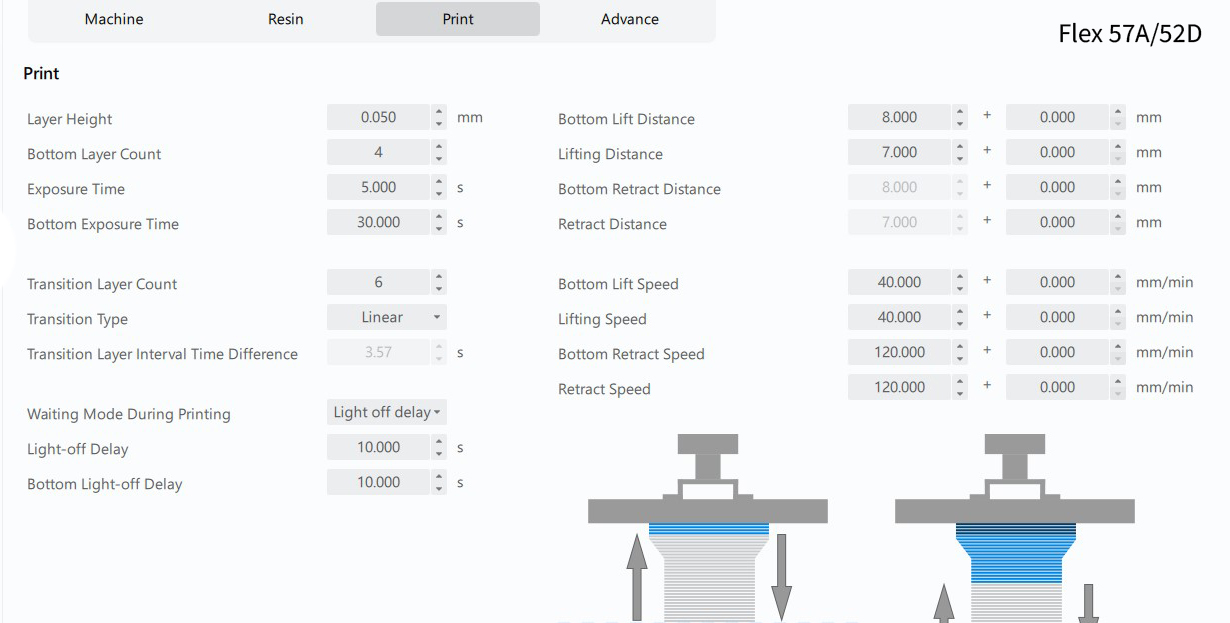
| Phrozen Make | Color-LCD | 35 ~ 45 sec | 8 ~ 11 sec | 50 μm |
| Phrozen Sonic mini | Mono-LCD | 25 ~ 35 sec | 4 ~ 6 sec | 50 μm |
| Miicraft 125 | DLP | 9 ~ 12 sec | 0.9 ~ 1.2 sec | 50 μm |
Shake thoroughly before use. Flex 52D has ultra-low viscosity (140~180 cps) — excellent flowability at room temperature, no warming required.
Use recommended exposure parameters above. Flex 52D's ultra-low viscosity enables fast detail filling with high print success rates. Clear resin has good light penetration — avoid over-exposure.
Flex 52D has good toughness — use a thin spatula to assist removal. Clear appearance lets you observe model integrity before removal.
Wash with 95% Alcohol or IPA or dedicated cleaning solution, gently agitate for 1~2 minutes. Ultra-low viscosity makes cleaning easier — residual resin removed more readily, helping maintain crystal clear appearance.
Post-cure using a UV curing station (365~405nm) for 10~30 minutes (adjust based on model thickness). ⚠️ Critical: Flex 52D's slow rebound properties are highly sensitive to post-cure time. Excessive post-curing significantly reduces slow rebound effect. Strictly keep within 30 minutes.
| Comparison | QTS Flex 52D | Standard Elastic Resin | Traditional Memory Foam | Standard Hard Resin |
|---|---|---|---|---|
| Slow Rebound | ✅ Unique Slow Rebound ⭐⭐⭐ | ❌ Fast rebound | ✅ Slow rebound | ❌ No elasticity |
| Print Precision | Ultra-High (Photopolymer) ⭐⭐⭐ | Ultra-High (Photopolymer) | Cannot 3D print | Ultra-High (Photopolymer) |
| Transparency | Crystal Clear ✅ | Depends on color | Opaque | Depends on color |
| Toughness (Elongation) | >100% ✅ | 50~700% | High | <10% |
| Structural Strength | Shore 52D (Hard) ✅ | Shore 8~85A (Soft) | Low | Shore 70~90D (Hard) |
| Custom Geometry | ✅ Any complex shape | ✅ Any complex shape | ❌ Difficult to customize | ✅ Any complex shape |
| Taiwan Local Support | ✅ QTS Professional | Depends on brand | — | Depends on brand |
A: Slow rebound means the material doesn't spring back immediately after compression or impact like ordinary elastomers — instead it slowly recovers its original shape. This stems from the material's "viscoelastic" behavior, similar to memory foam. Flex 52D's recovery speed depends on post-cure time and model thickness, typically recovering slowly over several seconds to tens of seconds.
A: Shore A and Shore D are two different hardness measurement scales. Shore A measures softer rubbers and elastomers (Flex 8A~85A); Shore D measures harder materials (hard rubber, rigid plastics). Shore 52D corresponds to hard plastic hardness — much harder than Shore 85A. What makes Flex 52D special: it has hard plastic hardness while simultaneously exhibiting slow rebound behavior and >100% elongation.
A: Very significantly. Longer post-cure time pushes the material toward ordinary hard resin with weaker slow rebound effect. Strictly control post-cure time within 10~30 minutes to preserve optimal slow rebound characteristics. For stronger slow rebound, try shorter post-cure time (but not below 10 minutes — surface may remain tacky).
A: Yes, Flex 52D is excellent for sports protective gear cushioning prototyping and small-batch production. Slow rebound fully absorbs impact energy, providing superior protection compared to ordinary elastomers. Clear appearance lets designers directly evaluate cushioning structure effectiveness.
A: The fundamental differences are "rebound speed" and "hardness scale." Flex 8A~85A uses Shore A scale — soft elastomers that spring back quickly after loading; Flex 52D uses Shore D scale — hard material with slow rebound (viscoelastic) behavior. Choose Flex series for fast-rebounding soft materials; choose Flex 52D for energy-absorbing, slow-recovering hard materials.
A: Clear appearance brings multiple practical advantages: 1) Visual validation — directly observe if slow rebound behavior matches design intent; 2) Stress distribution observation — observe internal stress distribution under load; 3) Academic research — visualized experiments in materials mechanics; 4) Design aesthetics — transparency itself is a design language, suitable for consumer electronics and premium design.
A: QTS Flex 52D is compatible with all 405nm light source LCD/DLP/SLA 3D printers, including Phrozen, Anycubic, Elegoo, Creality, FlashForge, eSUN, Miicraft, and other mainstream brands.
QTS brings 30+ years of chemical expertise. Flex 52D's slow rebound behavior is QTS's exclusive formula achievement, developed and manufactured entirely in Taiwan.
Complete printing parameter guidance and troubleshooting — especially precise post-cure time control for Flex 52D to help you achieve optimal slow rebound performance.
Compatible with all 405nm printers including Phrozen, Anycubic, Elegoo, Creality, FlashForge, and Miicraft.
Long-term trust from 8000+ Taiwan customers spanning designers, engineers, research institutions, and manufacturers across industries.
Made in Taiwan × Shore 52D Slow Rebound × Energy Absorbing × Crystal Clear
📧 Technical Support: info@qts.tw | 🌐 Official Store: shop.qts.tw