{{ 'fb_in_app_browser_popup.desc' | translate }} {{ 'fb_in_app_browser_popup.copy_link' | translate }}
{{ 'in_app_browser_popup.desc' | translate }}
QTS Flex 57A Clear Flexible Resin — Shore 57A TPU-like feel, 56 J/m notched impact strength, >80% elongation at break. Crystal clear, tough & resilient. Perfect for athletic shoe midsoles, impact-resistant housings, functional wearables, and industrial seals. Compatible with all 405nm LCD/DLP/SLA
Buy Together and Save More (At most {{ addItemQuantity }} item(s))
Not enough stock.
Your item was not added to your cart.
Not enough stock.
Please adjust your quantity.
{{'products.quick_cart.out_of_number_hint'| translate}}
{{'product.preorder_limit.hint'| translate}}
Limit {{ product.max_order_quantity }} per order.
Only {{ quantityOfStock }} item(s) left.
QTS Technology brings 30+ years of chemical R&D expertise to 3D printing materials.
All resins are developed and manufactured in Taiwan with strict quality control, trusted by 8000+ customers.
TPU-Like Toughness × Crystal Clear × 56 J/m Impact Strength
High-performance TPU-like elastomer
Superior impact resistance
Excellent rebound recovery
Higher hardness → Closer to TPU feel, better support, superior impact resistance
Notched impact strength of 56 J/m far exceeds standard flexible resins. Effectively absorbs impact energy without cracking, ideal for functional parts under repeated stress.
Shore 57A perfectly mimics high-performance TPU. Recovers quickly after compression without permanent deformation — the ideal prototype material for TPU product validation.
Optical transparency enables parts that combine toughness with light transmission — observe internal structures or create transparent wearables with cushioning function.
Enhanced performance without compromising user experience. Flex 57A maintains low odor characteristics for comfortable indoor use.
Compatible with all 405nm LCD/DLP/SLA 3D printers including Phrozen, Anycubic, Elegoo, Creality, FlashForge and other mainstream brands.
100% Taiwan-developed and manufactured with strict quality control. QTS Technology's 30+ years of chemical expertise, trusted by 8000+ customers.
QTS Flex 57A's crystal-clear transparency sets it apart in the flexible resin category. Create impact-resistant housings where internal structures need to be visible, transparent wearables with cushioning function, or light guide components and transparent seals. Transparent + Tough + Impact-Resistant — three properties perfectly combined, opening unlimited design possibilities.
Functional prototyping and testing of athletic shoe midsoles, outsoles, and insoles. Shore 57A perfectly simulates high-performance TPU footwear materials for pre-mold design validation.
Protective housings and cushioning components for robots, drones, or sports equipment. 56 J/m impact strength ensures parts won't crack under high-impact conditions.
Watch bands, braces, and sports wrist guard prototypes requiring structural support and flexibility. Transparency allows simultaneous evaluation of structural details and aesthetics.
Custom seals, gaskets, and anti-vibration feet. Excellent rebound ensures sealing effectiveness; transparency facilitates alignment during installation.
Flexible components requiring light transmission, such as light guides and transparent cushioning parts. Combine transparency with toughness for composite functional parts impossible with traditional materials.
Design validation before TPU product tooling. Accurately simulate the final product's feel and dynamic performance at minimal cost, significantly reducing tooling risk.
Photopolymer Resin Basic Properties (Liquid Material)
| Test Item | Value | Test Method |
|---|---|---|
| Appearance | Flowable Liquid | Visual |
| Color | Clear (Transparent) | Visual |
| Viscosity @25°C | 500 ~ 750 cps | Viscometer |
| Wavelength | 395 ~ 405 nm | — |
| Volume | 500 g | — |
Mechanical Properties After Curing
| Test Item | Value | Test Method |
|---|---|---|
| Shore Hardness A | 57 A | ASTM D2240 |
| Notched Izod Impact | 56 J/m | ASTM D256 |
| Elongation at Break | >80 % | ASTM D638 |
| Tensile Strength | 2.5 MPa | ASTM D638 |
| Print Technology | LCD / DLP / SLA | — |
| Printer Model | Screen Type | Bottom Exposure | Normal Layer Exposure | Layer Height |
|---|---|---|---|---|
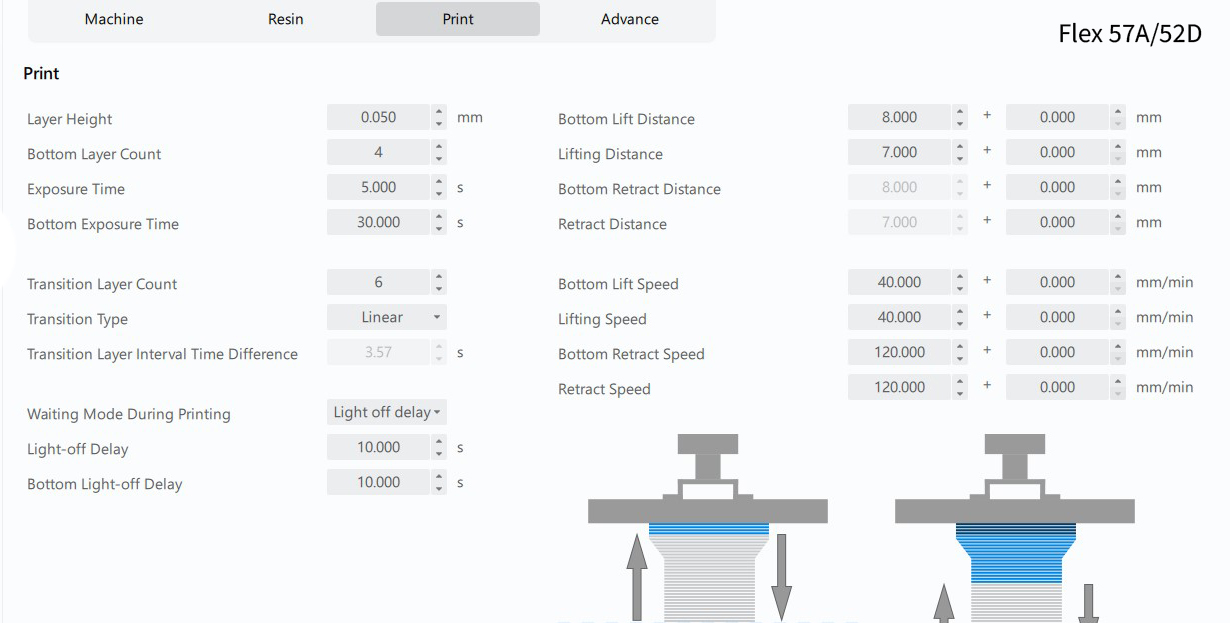
| Phrozen Make | Color-LCD | 30 ~ 40 sec | 8 ~ 10 sec | 50 μm |
| Phrozen Sonic mini | Mono-LCD | 20 ~ 30 sec | 4 ~ 5 sec | 50 μm |
| Miicraft 125 | DLP | 8 ~ 10 sec | 0.9 ~ 1.1 sec | 50 μm |
Shake thoroughly before use. Flex 57A has higher viscosity (500~750 cps); operate at 25°C or above, or gently warm to 30°C to reduce viscosity and improve flow.
Use the recommended exposure parameters above. For flexible resins, start from the lower end to avoid over-exposure that reduces elasticity.
Flexible parts are soft — handle gently to avoid deformation. Use a thin spatula to assist removal rather than forceful pulling.
Wash with IPA or dedicated cleaning solution, gently agitate for 1~2 minutes. Lightly press dry after washing to remove residual liquid before post-curing.
Post-cure at 60°C × 30~45 minutes using a UV curing station. Critical: Do not over-cure flexible resins — excessive post-curing reduces elasticity. Allow to cool to room temperature before testing flexibility.
A: The main difference is hardness and impact resistance. Flex 46A (Shore 46A) is softer with 120~160% elongation, ideal for applications requiring larger bending deformation. Flex 57A (Shore 57A) is harder with 56 J/m impact strength, closer to TPU feel, better for functional parts that must withstand impact forces like shoe soles and protective housings.
A: Flex 57A uses an anti-yellowing formula that maintains transparency long-term under normal indoor conditions. Avoid prolonged direct UV exposure (such as direct sunlight) to extend clarity. Store in a cool, dark place to preserve transparency.
A: Recommended post-cure: 60°C × 30~45 minutes. Post-cure time is critical for flexible resins — insufficient time results in soft, tacky parts; excessive time makes parts hard and loses elasticity. Strictly control post-cure time and test flexibility only after cooling to room temperature.
A: Compared to standard resins (100~300 cps), Flex 57A has higher viscosity that may affect flow at low temperatures. Operate at 25°C or above, or gently warm the resin bottle to 30°C to reduce viscosity and improve print success rate.
A: Yes, Flex 57A is ideal for footwear designers and R&D engineers. Shore 57A hardness closely matches high-performance TPU footwear materials, allowing accurate simulation of sole feel, rebound, and cushioning before tooling — significantly reducing mold risk and cost.
A: QTS Flex 57A is compatible with all 405nm light source LCD/DLP/SLA 3D printers, including Phrozen, Anycubic, Elegoo, Creality, FlashForge, eSUN, Miicraft, and other mainstream brands.
A: Shelf life is 12 months. Store in a cool, dry location (15~25°C), away from direct sunlight. Sealed storage extends usable life. After opening, use promptly and ensure the cap is tightly sealed after each use.
A: Handle flexible parts gently during washing — avoid vigorous scrubbing that may cause deformation. After IPA washing, lightly press dry the surface before post-curing.
QTS brings 30+ years of chemical expertise. All resins are developed and manufactured in Taiwan with consistent batch quality and strict quality control.
Complete printing parameter guidance and troubleshooting to help you achieve optimal elasticity and maximize material performance.
Compatible with all 405nm printers including Phrozen, Anycubic, Elegoo, Creality, FlashForge, and Miicraft.
Long-term trust from 8000+ Taiwan customers spanning designers, engineers, research institutions, and manufacturers across industries.
Made in Taiwan × TPU-Like Toughness × Crystal Clear × 56 J/m Impact Strength
📧 Technical Support: info@qts.tw | 🌐 Official Store: shop.qts.tw