{{ 'fb_in_app_browser_popup.desc' | translate }} {{ 'fb_in_app_browser_popup.copy_link' | translate }}
{{ 'in_app_browser_popup.desc' | translate }}
QTS Flex 85A Tough Elastic Resin (Black) — Flex series performance king. Shore 85A comparable to TPU engineering plastic, tensile strength 8~12 MPa, 45~55% elongation, ultra-low viscosity 150~250 cps (Flex series lowest). Extreme wear resistance, tough yet flexible. Perfect for industrial gears .
Buy Together and Save More (At most {{ addItemQuantity }} item(s))
Not enough stock.
Your item was not added to your cart.
Not enough stock.
Please adjust your quantity.
{{'products.quick_cart.out_of_number_hint'| translate}}
{{'product.preorder_limit.hint'| translate}}
Limit {{ product.max_order_quantity }} per order.
Only {{ quantityOfStock }} item(s) left.
QTS Technology brings 30+ years of chemical R&D expertise to 3D printing materials.
All resins are developed and manufactured in Taiwan with strict quality control, trusted by 8000+ customers.
Flex Series Performance King × TPU-Like × Extreme Wear Resistance × Industrial Gear Choice
Flex series highest, comparable to TPU engineering plastic
Engineering-grade strength for extreme loads
Flex series lowest viscosity — easiest to process
Flex 85A is the highest hardness, most TPU-like elastic resin in the series, designed for applications requiring extreme wear resistance and high strength
Shore 85A hardness with mechanical performance and durability rivaling popular TPU engineering plastics. Print functional parts with TPU-level strength at photopolymer precision — no FDM layer lines.
Shore 85A hardness delivers unmatched wear and cut resistance, withstanding high-intensity friction, rolling, and impact long-term. Ideal for industrial gears, high-wear casters, jigs, and fixtures.
45~55% elongation ensures parts absorb energy without brittle fracture under extreme impact — achieving the perfect "hard yet flexible" mechanical characteristic combining hardness and toughness.
The lowest viscosity in the Flex series ensures fast resin flow and fine detail filling, significantly improving print success rates and making post-processing cleaning simpler and more efficient.
Professional matte black appearance makes prototypes look closer to final products, suitable for direct use as functional parts. No additional painting required — perfect for industrial and automotive aesthetics.
100% Taiwan-developed and manufactured with strict quality control. QTS Technology's 30+ years of chemical expertise, trusted by 8000+ customers.
Gear, bushing, and drive component prototypes and small-batch production. Shore 85A extreme wear resistance and photopolymer precision ensure accurate gear tooth profiles for pre-mold design validation.
Production-line jigs, fixtures, and positioning blocks. High hardness and wear resistance ensure long-term dimensional stability. Create complex geometric tooling at photopolymer precision, dramatically reducing lead time.
High-wear industrial casters, inline skate wheels, and skateboard wheels. Extreme wear resistance ensures long-term durability; black finish suits professional sports equipment aesthetics.
Durable clips, wear pads, and high-strength buffers for engine compartments. TPU-like strength and wear resistance for accurate automotive part functional validation before tooling investment.
Wear-resistant components for inline skates, golf equipment, and sporting goods. Shore 85A hardness and wear resistance ensure stability under intense use; black finish suits professional design aesthetics.
Prototypes for any application requiring hard TPU or Nylon performance simulation. Validate TPU/Nylon part strength, wear resistance, and functionality at photopolymer precision before expensive tooling.
Photopolymer Resin Basic Properties (Liquid Material)
| Test Item | Value | Test Method |
|---|---|---|
| Appearance | Flowable Liquid | Visual |
| Color | Black | Visual |
| Viscosity @25°C | 150 ~ 250 cps (Flex Series Lowest) | Viscometer |
| Wavelength | 395 ~ 405 nm | — |
| Volume | 500 g | — |
Mechanical Properties After Curing
| Test Item | Value | Test Method |
|---|---|---|
| Shore Hardness A | 85 A (Comparable to TPU Engineering Plastic) | ASTM D2240 |
| Tensile Strength | 8 ~ 12 MPa | ASTM D638 |
| Elongation at Break | 45 ~ 55 % (Tough yet flexible) | ASTM D638 |
| Print Technology | LCD / DLP / SLA | — |
| Printer Model | Screen Type | Bottom Exposure | Normal Layer Exposure | Layer Height |
|---|---|---|---|---|
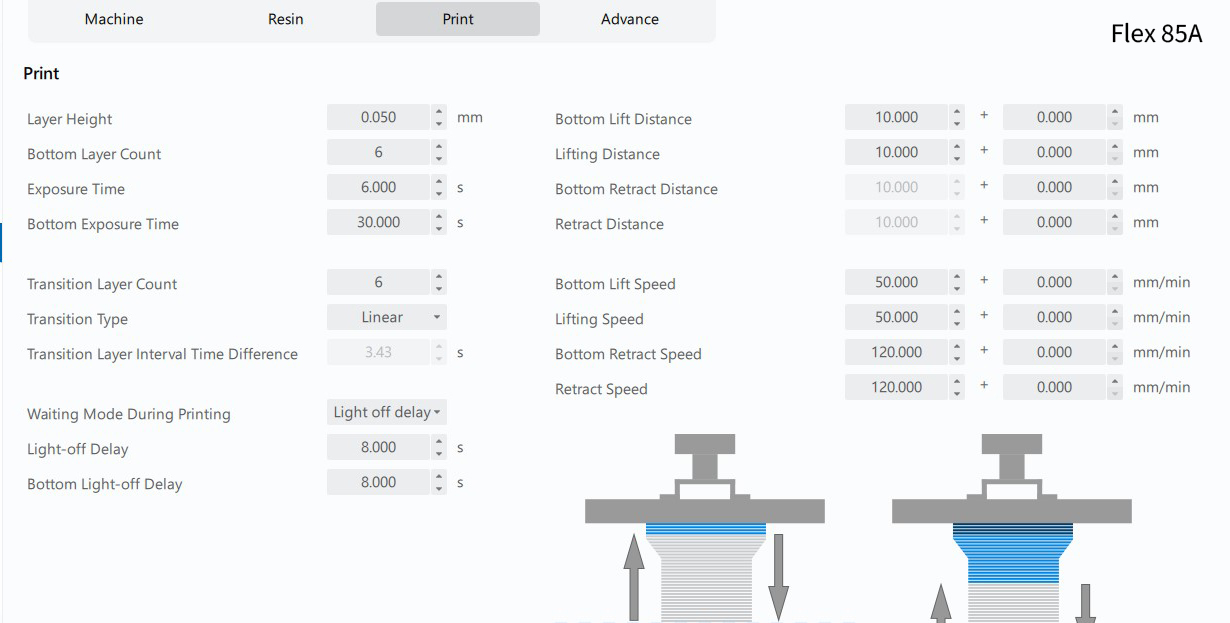
| Phrozen Make | Color-LCD | 35 ~ 45 sec | 9 ~ 12 sec | 50 μm |
| Phrozen Sonic mini | Mono-LCD | 25 ~ 35 sec | 5 ~ 6 sec | 50 μm |
| Miicraft 125 | DLP | 9 ~ 12 sec | 1.0 ~ 1.3 sec | 50 μm |
Shake thoroughly before use. Flex 85A has the lowest viscosity in the Flex series (150~250 cps) — excellent flowability at room temperature, no warming required.
Use recommended exposure parameters above. Although higher hardness, still avoid over-exposure. Black resin has slightly lower light penetration — ensure adequate bottom layer exposure time.
Flex 85A's higher hardness makes removal easier. Use a thin spatula to assist. For precision parts like gears, handle carefully to avoid damaging tooth profiles.
Wash with 95% Alcohol or IPA or dedicated cleaning solution, gently agitate for 1~2 minutes. Flex 85A's ultra-low viscosity (150~250 cps) makes cleaning easier and more efficient — residual resin is removed more readily.
Post-cure using a UV curing station (365~405nm) for 10~60 minutes (adjust based on model thickness). Allow to cool to room temperature before performance testing. Note: Even at higher hardness, excessive post-curing still affects elasticity — keep within recommended range.
| Comparison | QTS Flex 85A | FDM TPU Printing | Traditional Molding | Standard Elastic Resin |
|---|---|---|---|---|
| Hardness | Shore 85A (TPU-Like) ⭐⭐⭐ | Shore 80~95A | Customizable | Shore 20~50A |
| Print Precision | Ultra-High (Photopolymer) ⭐⭐⭐ | Low (visible layer lines) | High | Ultra-High (Photopolymer) |
| Wear Resistance | Extreme ✅ | Average | Depends on material | Average |
| Tooling Cost | Zero ✅ | Zero | Tens of thousands | Zero |
| Lead Time | Hours ✅ | Hours | Weeks to months | Hours |
| Fine Detail | Excellent (gear-ready) ✅ | Poor (layer lines) | High | Excellent |
| Taiwan Local Support | ✅ QTS Professional | Depends on brand | Depends on supplier | Depends on brand |
A: Flex 85A's Shore 85A hardness and 8~12 MPa tensile strength are indeed very close to typical TPU engineering plastic specifications. The key advantage is photopolymer precision enabling fine geometric structures impossible with FDM TPU (precision gears, small clips). The main difference is elongation (45~55%) is slightly lower than high-elasticity TPU, but sufficient for most industrial applications.
A: Yes, Flex 85A is ideal for industrial gear prototyping and small-batch production. Shore 85A extreme wear resistance combined with photopolymer precision enables accurate gear tooth profiles, allowing pre-mold design validation and significantly reducing tooling risk.
A: Flex 85A (Shore 85A) is harder and closer to TPU engineering plastic than Flex 68A (Shore 68A). Flex 85A has superior wear resistance, better for gears and fixtures requiring extreme wear resistance; elongation (45~55%) is slightly lower than Flex 68A (90~120%) but still provides adequate elasticity. Choose Flex 85A for maximum wear resistance and closest-to-TPU performance; choose Flex 68A for higher elasticity and rebound.
A: Flex 85A's viscosity (150~250 cps) is the lowest in the Flex series, bringing multiple benefits: better resin flow for quickly filling fine gear tooth gaps and complex structures; higher print success rates; easier post-processing cleaning with residual resin removed more readily.
A: Absolutely. Flex 85A's TPU-like strength and wear resistance make it ideal for automotive part functional prototyping — engine compartment clips, wear pads, buffer blocks — allowing accurate functional validation before expensive tooling investment.
A: QTS Flex 85A is compatible with all 405nm light source LCD/DLP/SLA 3D printers, including Phrozen, Anycubic, Elegoo, Creality, FlashForge, eSUN, Miicraft, and other mainstream brands.
A: Store in a cool, dry location (15~35°C), away from direct sunlight. Seal tightly after each use. Filter used resin before storing separately. Never pour liquid resin directly down the drain — fully cure to solid state first, then recycle as general solid waste. Always wear gloves, safety goggles, and protective clothing during operation.
QTS brings 30+ years of chemical expertise. All resins are developed and manufactured in Taiwan with consistent batch quality and strict quality control.
Complete printing parameter guidance and troubleshooting to help you achieve optimal industrial performance and maximize material capabilities.
Compatible with all 405nm printers including Phrozen, Anycubic, Elegoo, Creality, FlashForge, and Miicraft.
Long-term trust from 8000+ Taiwan customers spanning designers, engineers, research institutions, and manufacturers across industries.
Made in Taiwan × Shore 85A TPU-Like × Extreme Wear Resistance × Industrial Gear Choice
📧 Technical Support: info@qts.tw | 🌐 Official Store: shop.qts.tw